Stay inside historic Chester.
An 1880s terrace inside the Roman city walls.
An 1880s terrace inside the Roman city walls.
The amphitheatre — built in the late first century — with the ruins of St John’s behind the trees.
The sandstone arch dates from 1768–69. John Douglas’s wrought-iron clock was added in 1899, above the city walls at Eastgate.
Refounded as a Benedictine abbey in 1092; the cathedral of Chester since 1541.
Chester’s oldest bridge — thought built from 1387 — and rowing boats out from the Groves. The rest of the city’s story waits just below.
A hand-made miniature of real places. Every scene is modelled from a real photograph.
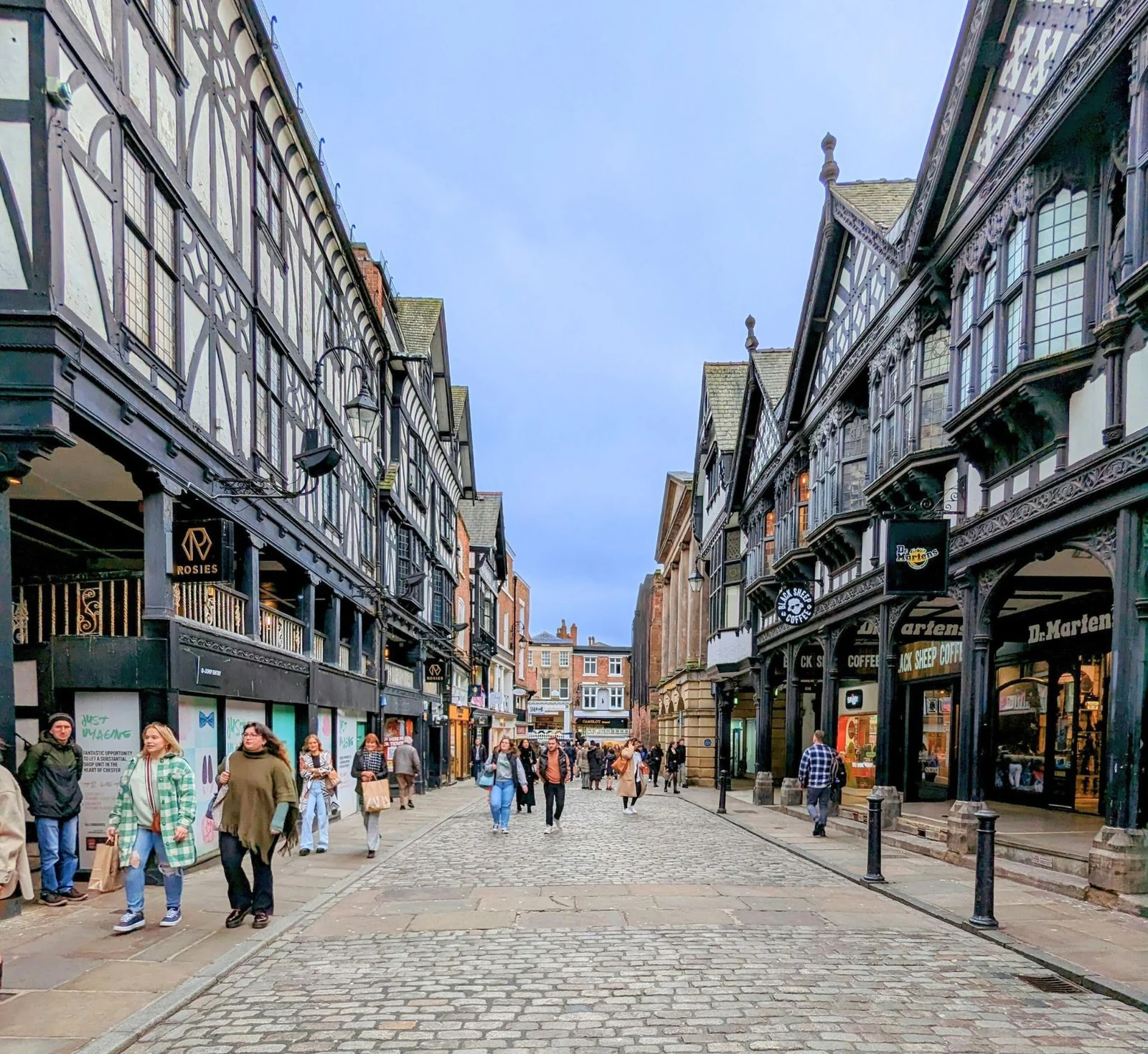
The journey above is only the start. Roman defences, medieval Rows and later civic landmarks still sit together in Chester's walkable centre; the miniatures below group real places by the age that shaped what you see today.
Read the facts behind ChesterEvery place is within walking distance of the house. Find these places on the interactive Explore Chester map.
Each miniature is © PAUSEUK LIMITED, modelled from a verified photograph of the real place. See the sources, credits and licensing.
Late 1st century to c. AD 400
The legionary fortress of Deva is still underfoot. These are the places where Roman Chester shows itself.

built in the late 1st century AD
The Roman arena beside St John's, built in the late first century AD and still cut into the ground.

early 2nd century AD
A shrine to Minerva cut into the rock of Edgar's Field, watching over the old river crossing.

Roman, probably 2nd century AD
Masonry by the Roodee from the days when ships still reached the fortress.

mid-20th-century garden of Roman remains
A garden created in the mid 20th century around repositioned Roman columns and stonework.
c. 1066 to 1485
Castle, abbey, bridge and gates — the city that grew inside the walls after the Normans arrived.

in records by c. 1080
The church at Chester Cross, in the records by around 1080 and rebuilt more than once since.

refounded as an abbey in 1092
Refounded as a Benedictine abbey in 1092 and a cathedral since 1541; the great west front faces St Werburgh Street.

1093
Built for St Werburgh's Abbey to power the Dee Mills; the river still folds over it today.

earliest fabric c. 1180
Stonework and reused roof timbers from around 1180 hide inside this much-altered house.

probably 13th century
A wall tower long before it earned its Civil War name; restored from 1612 and repaired after the siege.

founded 1070; Agricola Tower c. 1210
Founded by William I; the Agricola Tower, gatehouse and chapel are the oldest surviving parts.

c. 1275
A small gate cut through the walls for the monks of St Werburgh's, by permission of Edward I.

c. 1300
The gateway into the abbey precinct off Northgate Street, altered around 1800 but medieval at heart.

oldest fabric late 14th century
Its undercroft and lower chimney survive from the late 14th century, beneath a later town house.

1387
Chester's oldest bridge, rebuilt under Richard II's Letters Patent of 1387 on a far older crossing.
1485 to 1714
The black-and-white city most visitors picture — merchant houses, inns and the Rows at their proudest.

first race 1539
The Roodee ran its first race on Shrove Tuesday in 1539, and still races today.

1591
Built for Sir Peter Warburton in 1591; home to the Stanleys of Alderley from 1596.

17th century
A 17th-century coaching inn, partly refronted later that century and still pouring today.

probably 1603
A Lower Bridge Street survivor, probably of 1603 despite the earlier date it likes to claim.

1664
Raised in 1664 for the Earl of Shrewsbury — one of the last great timber-framed town houses.

early 17th century, restored 1890s
An early-17th-century rebuild over medieval undercrofts, heavily restored by T. M. Lockwood in the 1890s.
1714 to 1837
Elegant stone arrived: new gates in the old walls and a school with a founding purpose.

built 1717
Founded in 1700 by Bishop Stratford; the present building followed in 1717.

1781-2
Joseph Turner's arch replaced the old gate over Lower Bridge Street in 1781-2.

1810
Thomas Harrison's clean neoclassical arch of 1810, on the site of the medieval gate and gaol.
1837 to 1901
The city dressed itself for visitors — a great park by the river and a museum full of its own past.

laid out 1867-1874
One of England's finest Victorian parks, laid out from 1867 above the Groves.

completed 1869
W. H. Lynn's Gothic town hall, completed 1869 after fire destroyed the old Exchange.

c. 1880
The riverside bandstand of about 1880, paid for by Charles Brown of the Chester department store.

built 1885-6
Thomas Meakin Lockwood's museum of 1885-6, keeper of Chester's Roman tombstones.
1901 to today
The story kept going: a rebuilt river crossing, a new gate in the Roman walls and an Odeon reborn.

present bridge opened 1923
First bridged in 1852; the bridge you cross today opened on 18 April 1923.

1938
The newest gate in the old walls, built in 1938 to let traffic through gently.

1936 Odeon, reopened 2017
A 1936 Odeon that became Storyhouse in May 2017 — cinema, theatre and library in one.